
Imagine you’re relaxing on a warm afternoon when suddenly, a rhythmic thump-thump-thump or a sudden BANG echoes from your backyard. It sounds like someone is trapped inside your air conditioner trying to get out.
While your AC isn’t actually haunted, those noises are its way of screaming for help. At Magic Electric, Plumbing, Heating & Air, we know that a noisy HVAC unit is often a warning sign of an impending breakdown.
Let’s explore why your outdoor unit is acting up, what you can fix yourself, and when it’s time to call in the pros.
What causes a loud thumping noise in an outdoor AC unit?
When you hear a consistent “thumping” sound, the culprit is almost always something that rotates. Think of it like a ceiling fan with a loose blade; every time it spins, the imbalance creates a rhythmic vibration.
In an outdoor condenser unit, this is usually tied to the fan assembly. If a fan blade becomes slightly bent or if the motor’s mounting bolts have vibrated loose over the years, the entire assembly will wobble. As it reaches high speeds, that wobble turns into a heavy thumping sound as the blades or the motor housing strike the protective metal cage.
Another common cause of thumping is “slugging.” This occurs when liquid refrigerant, rather than gas, enters the compressor. The compressor is designed to squeeze gas, and trying to compress a liquid is like trying to squeeze a brick. This creates a heavy, labored thumping sound that indicates your system is under extreme liquid pressure stress.

Why does my AC unit make a loud banging sound when it starts?
A sudden “bang” at startup is often more jarring than a steady thump. This is frequently referred to as a “hard start.”
As units age, the compressor (the large pump inside your unit) may struggle to get moving. If the internal mounting springs that support the compressor motor become weak or snap, the motor will “jump” when it kicks on. Without the springs to absorb that torque, the heavy metal compressor slams against the exterior housing of the unit.
Additionally, banging can be caused by a loose part that has finally disconnected. If a bolt or a piece of the fan assembly has completely sheared off, it may be tossed around inside the unit by the air currents, slamming into the metal sides like a pinball.
Can debris inside the unit cause these noises?
Absolutely. In fact, this is the first thing you should check because it’s a fix you can often handle yourself. Your outdoor unit is exposed to the elements 365 days a year.
Common items that find their way inside include:
- Small tree branches or twigs.
- Large mulch chips.
- Hale or ice chunks (during winter or shoulder seasons).
- Rocks kicked up by a lawnmower.
- Nesting materials from birds or rodents.
When the fan turns on, these objects get caught in the “cyclone” created by the blades. A twig hitting a fan spinning at 1,000 RPM sounds remarkably like a hammer hitting a metal sheet.
Is a banging noise a sign of a failing compressor?
Unfortunately, yes. The compressor is the most expensive part of your HVAC system. Inside the compressor are several small parts, including valves, connecting rods, and pistons.
If any of these internal components break or become loose, they’ll rattle around inside the sealed compressor canister. Because the compressor is a hermetically sealed unit, these internal parts can’t be repaired individually. It usually means a full compressor replacement is necessary.
How do loose refrigerant lines contribute to the noise?
Sometimes the noise isn’t coming from inside the unit, but from the pipes attached to it. Your AC uses copper lines to move refrigerant back and forth. These lines carry high-pressure gas and liquid.
If the plastic or metal clamps that secure these lines to the side of your house become loose, the lines will vibrate. This vibration can cause the copper to “slap” against your siding or the unit’s chassis, creating a rhythmic banging or knocking sound that echoes through your walls. Over time, this friction can actually wear a hole in the copper, leading to a refrigerant leak.
What are the risks of ignoring these sounds?
Ignoring a thumping or banging noise is a gamble where the house always wins. What starts as a $150 minor repair can quickly spiral into a $5,000 system replacement.
- Motor Burnout: If the fan is thumping because it’s unbalanced, the motor has to work twice as hard to maintain speed. This leads to overheating and total motor failure.
- Refrigerant Leaks: Constant vibration causes “friction leaks.” If a vibrating part rubs against a refrigerant coil, it will eventually thin the metal until a leak occurs.
- Total Compressor Failure: If the banging is internal to the compressor, the metal shavings from the broken part will circulate through your entire system, contaminating the coils and the indoor unit.
How can I safely troubleshoot the unit myself?
Before you call a technician, there are a few safe steps you can take to identify the problem.
Safety First: Always turn off the power to the unit at the thermostat AND at the outdoor disconnect box before inspecting it.
- The Visual Inspection: Look through the top grille of the unit with a flashlight. Can you see a stick or a rock?
- The Fan Check: Using a long screwdriver (with the power OFF), gently nudge the fan blade. Does it spin freely, or does it wobble and hit the side?
- The Panel Test: Gently shake the outer panels of the AC. If they rattle easily, you may just have a loose screw that needs tightening.
- The Ground Check: Ensure the concrete pad your AC sits on hasn’t shifted. If the unit is tilted, the fan and compressor will be off-balance, causing thumping.
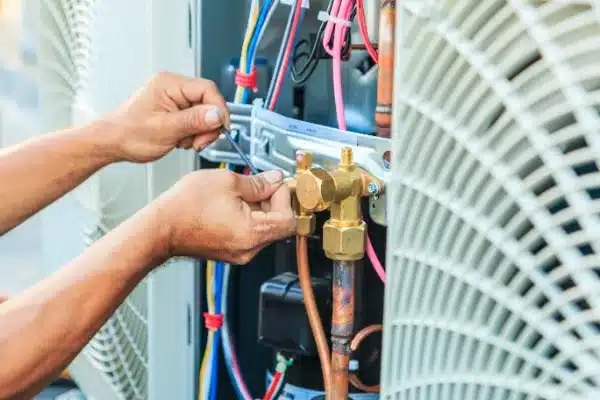
When should I call a professional for HVAC repair?
While clearing out a stick is a DIY job, most thumping and banging sounds require professional tools and expertise. You should call Magic Electric, Plumbing, Heating & Air immediately if:
- The noise is coming from inside the sealed compressor.
- The fan motor is hot to the touch or smells like burning plastic.
- You see any oily residue (this indicates a refrigerant leak).
- The unit trips your circuit breaker when it tries to start.
- The banging is accompanied by the AC failing to cool your home.
Professional technicians have the equipment to measure “refrigerant pressure” and “electrical draw,” which tells them exactly what’s happening inside the parts you can’t see.
How can regular maintenance prevent these noises?
The best way to fix a banging AC is to never let it start banging in the first place. Annual maintenance is the “oil change” for your home’s cooling system.
During a professional tune-up, a technician will:
- Tighten All Connections: They ensure the motor mounts and electrical terminals are snug.
- Clean the Coils: Removing dirt reduces the “load” on the compressor, preventing hard starts.
- Lubricate Moving Parts: This reduces the friction that leads to thumping.
- Balance the Fan: Technicians can detect slight imbalances before they become loud thumps.
Conclusion
A thumping or banging noise in your outside AC unit is your home’s early warning system. Whether it’s a simple stray branch or a compressor crying out for help, addressing the sound early will save you from a hot, uncomfortable house and a massive repair bill.
If your AC is making sounds that belong in a percussion ensemble rather than a cooling system, don’t wait for it to fail completely. Contact Magic Electric, Plumbing, Heating & Air for all your plumbing and electrical repair needs, as well as your HVAC emergencies. Our team of experts is ready to restore the “magic” of a quiet, cool home.
AC Banging Noises Frequently Asked Questions (FAQ)
Q: Is it safe to run my AC if it’s making a banging noise?
A: No. If you hear a heavy banging or thumping, you should turn the system off immediately. Continuing to run the unit can cause “secondary damage,” where a loose part breaks other components, significantly increasing your repair costs.
Q: Can a dirty air filter cause the outside unit to thump?
A: Indirectly, yes. A clogged air filter restricts airflow, which can cause the indoor evaporator coil to freeze. This can lead to liquid refrigerant flowing back to the outdoor compressor (slugging), which causes a heavy thumping sound.
Q: How much does it usually cost to fix a banging noise?
A: It depends on the cause. Removing debris might only cost a service call fee. Replacing a fan motor typically ranges from $300 to $600. However, if the compressor has failed internally, you may be looking at $1,500 to $3,000, at which point replacing the unit is often more cost-effective.