
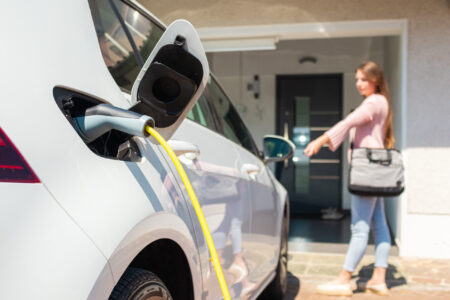
Congratulations! If you’re reading this, you likely just bought an electric vehicle (EV) or you’re thinking about adding charging stations to your business. The shift to electric is exciting, but it comes with one big question: How do I keep this thing charged?
While the “trickle charger” that came with your car is fine for emergencies, waiting 24 hours for a full battery gets old fast. At Magic Electric, Plumbing, Heating & Air, we help homeowners and business owners bridge the gap between “range anxiety” and a fully powered morning commute.
Whether you need a residential speed boost or a commercial fleet solution, this guide covers everything you need to know about EV charger installation.
What Are the Different Levels of Charging?
Understanding the “Levels” is the first step to picking the right equipment. Think of them like filling a swimming pool: you can use a garden hose, a fire hose, or a massive pipe.
- Level 1 (The Garden Hose): This is the standard cord that plugs into a regular 120-volt household outlet. It adds about 3 to 5 miles of range per hour. It’s great for hybrids but painfully slow for full EVs.
- Level 2 (The Fire Hose): This is the gold standard for home and business charging. Using a 240-volt circuit (like your dryer), it charges 5x to 7x faster than Level 1. You can fully charge most EVs overnight.
- Level 3 (The Massive Pipe): Also known as DC Fast Charging. These are the commercial stations you see at shopping centers. They are incredibly expensive and require industrial-grade power, making them rare for residential use but great for specific commercial applications.

Why Upgrade to a Level 2 Home Charger?
If you drive more than 30 miles a day, a Level 1 charger probably won’t cut it. Upgrading to a Level 2 station at home transforms your EV ownership experience.
- Convenience: Plug in at 7 PM, and you are at 100% by 7 AM. No more planning your day around public charging stations.
- Cost Savings: Charging at home is almost always cheaper than using public networks. Plus, smart Level 2 chargers can schedule charging for off-peak hours when electricity rates are lower.
- Home Value: As EVs become standard, a garage pre-wired for Level 2 charging is becoming a desirable feature for homebuyers.
Can My Home Electrical Panel Handle It?
This is the most critical question we answer during our initial inspection. EV chargers draw a significant amount of continuous power, often 30 to 50 amps.
If you have an older home with a 100-amp electrical panel, adding a charger might overload your system, leading to tripped breakers or safety hazards. In these cases, Magic Electric, Plumbing, Heating & Air may recommend a “Service Upgrade” or a “Panel Upgrade” to 200 amps. This ensures your home has enough juice to run the A/C, the oven, and charge the car simultaneously without any issue.
Hardwired vs. Plug-In: Which Setup is Best?
When installing a Level 2 charger, you generally have two choices:
- Hardwired: The charger is permanently connected to your electrical wiring.
- Plug-In (NEMA 14-50): An electrician installs a heavy-duty 240V outlet, and you plug the charger in.
Which should you choose?
We often recommend hardwiring. It is generally safer because it eliminates a connection point (the plug) that can wear out or heat up over time. Hardwired units also often look cleaner and can support higher charging speeds than plug-in models. However, if you plan to move soon and want to take your charger with you, a plug-in installation might be the better route.
Why Install EV Chargers at Your Business?
For business owners, installing EV charging stations isn’t just about electricity, it’s a competitive advantage.
- Attract High-Value Customers: EV drivers need places to park and charge. If you run a restaurant, hotel, or retail store, a charger encourages customers to stay longer and spend more.
- Employee Retention: Workplace charging is a highly sought-after perk. It allows employees to commute for pennies on the dollar.
- Fleet Management: If your business uses company cars, switching to electric fleets cuts fuel and maintenance costs significantly provided you have the infrastructure to keep them running.

Why Hire a Professional Like Magic Electric?
- Safety First: Improper wiring can lead to melted components or house fires. Our licensed electricians ensure the wire gauge, conduit, and breaker are perfectly matched to the load.
- Code Compliance: We handle the permits. Municipalities have strict codes regarding where chargers can be placed and how they must be grounded.
- Warranty Protection: Many EV charger manufacturers void their warranty if the unit isn’t installed by a certified professional.
Ready to Power Up?
Don’t let a slow charger stall your electric journey. Whether you need a simple NEMA 14-50 outlet for your garage or a bank of commercial chargers for your office lot, Magic Electric, Plumbing, Heating & Air has the expertise to get it done right.
Contact Magic Electric, Plumbing, Heating & Air for your plumbing and electrical repair needs today!
Electric Car Charger Installation: Frequently Asked Questions (FAQ)
Q: How much does it cost to install an EV charger?
A: The cost varies widely based on your home’s current electrical setup. A simple installation near the panel might cost between $500 and $1,200 (plus the cost of the charger). However, if you need a panel upgrade or extensive wiring to a detached garage, the price will be higher. We provide upfront pricing so you know exactly what to expect.
Q: Do I need a permit to install a car charger?
A: Yes, almost all municipalities require an electrical permit for EV charger circuits. This is for your safety. Magic Electric handles the permitting process and schedules the required city inspections for you.
Q: Can I install a charger outside?
A: Absolutely. Most modern EV chargers are NEMA-4 rated, meaning they are weather-resistant and designed to withstand rain, snow, and dust. We just need to ensure the wiring running to the exterior is properly protected.
Q: Will a Tesla charger work with other cars?
A: Tesla uses a proprietary connector (NACS), while most other EVs use the J1772 connector. However, adapters are available for both directions. If you want a “universal” solution for your home or business, we can recommend chargers that work with all vehicles.
Q: How long does the installation take?
A: A standard installation usually takes 2 to 4 hours. If a panel upgrade is required, it may take a full day.