
Imagine this: The storm outside is howling, the grid goes down, and your home plunges into darkness. You confidently head out to your backup generator, start the engine, and hear that reassuring roar. But when you flip the transfer switch or plug in your fridge… nothing happens. The engine is humming, but the lights stay off.
It’s a frustrating and all-too-common scenario for homeowners in Twin Falls, ID. You have mechanical power (the engine is working), but you lack electrical power (the output). Why does this happen, and more importantly, how do you fix it?
At Magic Electric, Plumbing, Heating & Air, we understand that a generator is only as good as the electricity it delivers. In this guide, we’ll walk you through the most common reasons why a generator runs but produces no power, ranging from simple switch flips to complex internal repairs.
Is Your Main Circuit Breaker Tripped?
Before you break out the tool belt or start panicking about expensive repairs, start with the simplest explanation. Is the circuit breaker on the generator tripped?
Generators are designed to protect themselves from damage. If you plug in too many appliances at once, like a heater, a sump pump, and a refrigerator, the demand (load) might exceed the generator’s capacity. When this happens, the onboard circuit breaker flips to cut the flow of electricity, protecting the internal windings from melting.
How do you check the breaker?
Locate the main outlet panel on your generator. You will typically see a toggle switch or a push-button breaker. If the switch is in the “Off” or center position, or if the button has popped out, it has tripped.
- Disconnect all loads: Unplug all cords and appliances.
- Reset the breaker: Flip the switch firmly to “Off” and then back to “On,” or press the reset button.
- Reconnect slowly: Plug devices in one by one to avoid overloading the unit again.
Could It Be a GFCI Outlet Lockout?
Modern portable generators are equipped with Ground Fault Circuit Interrupter (GFCI) outlets, similar to the ones in your bathroom or kitchen. These are highly sensitive to moisture and ground faults.
If you’re running your generator in damp conditions (which is common during storms), a small amount of moisture can trip the GFCI outlet. Even if the main breaker is fine, a tripped GFCI means that specific outlet won’t work.
How do you reset a GFCI?
Look for the small “Test” and “Reset” buttons on the face of the outlet. If the “Reset” button has popped out:
- Unplug the appliance.
- Press the “Reset” button firmly until it clicks and stays flush.
- If it immediately pops back out, you may have a short in your appliance or water inside the outlet housing.
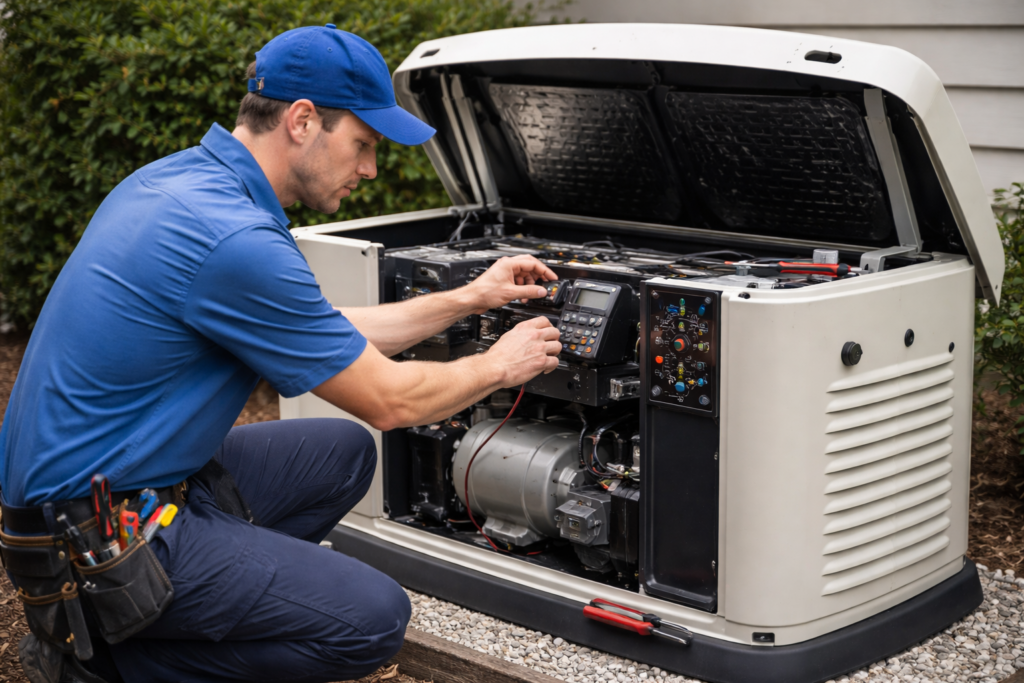
Has Your Generator Lost Its Residual Magnetism?
Generators work on the principle of electromagnetic induction. They do not have permanent magnets inside. Instead, they rely on a small amount of “leftover” magnetism in the generator core to create the initial spark of electricity when the engine starts.
If your generator has sat unused for a long time (6 months or more) or was shut down while a heavy load was still attached, it can lose this residual magnetism. Without it, the generator spins, but the magnetic field never builds up, resulting in zero power output.
How does loss of residual magnetism happen?
- Long-term storage: The magnetic field naturally dissipates over time.
- Improper shutdown: Turning off the engine before unplugging appliances can drain the field.
Restoring this magnetism is called “flashing the field.” While there are DIY methods involving drills or batteries, this involves working with live electrical terminals. For safety, we highly recommend calling a professional technician from Magic Electric, Plumbing, Heating & Air to perform this service. Incorrectly flashing a field can damage the generator’s electronics.
Is the Automatic Voltage Regulator (AVR) Faulty?
If your generator has power but it’s extremely weak (lights are dim and yellow) or fluctuating wildly, the culprit is often the Automatic Voltage Regulator (AVR).
The AVR is the brain of your generator’s output. It monitors the voltage being produced and tells the internal components to adjust the magnetic field to keep the power steady at 120V or 240V. Over time, the capacitors inside the AVR can dry out, or the electronics can fail due to heat and vibration.
Symptoms of a bad AVR:
- Zero output: The generator produces absolutely no electricity.
- High voltage: The generator puts out a dangerous surge (e.g., 160V instead of 120V), which can destroy your electronics.
- Low voltage: Lights are dim, and motors hum but won’t start.
Because the AVR is a sealed electronic component, it usually can’t be repaired, therefore, it must be replaced.
Are the Carbon Brushes Worn Out?
Many conventional generators use “brushes” to transfer electricity from the spinning rotor to the stationary wires. These brushes are small blocks of carbon held in place by springs. They ride against metal rings (slip rings) on the rotor shaft.
Think of these like the brake pads on your car. They’re designed to wear down over time. If they become too short, cracked, or get stuck in their holders, they won’t make contact with the slip rings. When contact is broken, the flow of electricity stops instantly.
Signs of worn brushes:
- Intermittent power: Power cuts in and out as the generator vibrates.
- Sparking: You may see excessive blue sparking inside the generator head.
- Age: If your generator has seen hundreds of hours of use, the brushes are likely due for a change.
Replacing brushes is a standard maintenance task for the team at Magic Electric, Plumbing, Heating & Air, but it requires careful work because it involves opening the generator head.
Is the Capacitor Blown (Brushless Generators)?
Not all generators use brushes. “Brushless” generators use a capacitor to help build up the electrical charge. A capacitor acts like a temporary storage tank for electricity.
Capacitors are prone to failure if the generator is stored in extreme heat or if the unit is frequently overloaded. A “blown” capacitor is essentially a dead battery. It won’t be able to hold the charge needed to induce a current.
How to spot a bad capacitor:
Sometimes you can see physical damage. A bad capacitor might look swollen, cracked, or leak an oily fluid. However, oftentimes they look perfectly fine on the outside but fail a multimeter test. If you have a brushless unit that runs but produces no power, the capacitor will be the first internal part we check.

Could Loose Wiring or Connections be the Cause?
Generators vibrate, a lot. Even the smoothest running engines produce constant vibration that can rattle screws loose over time.
Inside the control panel of your generator, there is a web of wires connecting the outlets, breakers, switches, and the alternator. If a single wire vibrates loose, becomes disconnected, or frays against a metal edge, the circuit is broken.
Common wiring issues:
- Loose ground wire: Can prevent the unit from producing power for safety reasons.
- Corroded terminals: If the generator is stored in a damp shed or garage, rust can form on the electrical connections, blocking the flow of power.
- Mouse damage: Unfortunately, rodents love to nest inside warm generator housings and chew on wires.
Why is Routine Maintenance Crucial?
The vast majority of “run but no power” issues can be prevented with regular generator maintenance. A generator is not a “set it and forget it” appliance. Just like your car, it needs regular check-ups to ensure it is ready for the next emergency.
Maintenance checklist to prevent power loss:
- Run it regularly: Run your generator for 30 minutes every month to keep the residual magnetism charged and the engine lubricated.
- Check the oil: Low oil sensors can sometimes cut the ignition, but they can also cause erratic behavior.
- Inspect brushes: Have a pro check the brush wear every 100 hours of operation.
- Keep it clean: Dust and debris can clog the cooling vents, overheating the AVR and capacitors.
Why Choose Magic Electric, Plumbing, Heating & Air?
Troubleshooting electrical issues on a running generator can be dangerous.You’re dealing with a machine that produces lethal voltage, runs on combustible fuel, and has hot, moving parts.
When you call Magic Electric, Plumbing, Heating & Air, you aren’t just getting a repair, you’re getting peace of mind. Our licensed technicians in Twin Falls, ID, are trained to:
- Diagnose quickly: We use advanced multimeters and diagnostic tools to pinpoint the failure (AVR, Stator, Rotor, or Capacitor) without guessing.
- Safety first: We follow strict safety protocols to protect your home and your family from electrical hazards.
- Upfront pricing: We explain the problem and the cost before we start any work.
Don’t let a power outage leave you in the dark even when your generator is running. Whether it’s a simple breaker reset or a complex repair, we have the skills to get your lights back on.
Contact Magic Electric, Plumbing, Heating & Air today for all your plumbing and electrical repair needs. We’re here to ensure your home stays powered, warm, and safe.
Generator Runs but No Power: Frequently Asked Questions (FAQ)
Q: Why is my generator running but not producing electricity?
A: The most common reasons are a tripped circuit breaker, a tripped GFCI outlet, or a loss of residual magnetism. More serious internal issues can include a faulty Automatic Voltage Regulator (AVR), worn carbon brushes, or a blown capacitor.
Q: How do I fix a generator that lost its magnetism?
A: You can often restore magnetism by “flashing the field,” which involves briefly introducing a 12V DC current to the generator’s brushes. However, this requires working with live wires and can be dangerous. It is best to hire a professional electrician to perform this task safely.
Q: Can a bad spark plug cause a generator to produce no power?
A: Generally, no. A bad spark plug affects the engine’s ability to run. If the engine is running smoothly but there is no power, the issue is likely in the electrical head (alternator), not the engine itself. However, if the engine is surging or running rough due to a bad plug, the voltage might fluctuate too much for the power to stabilize.
Q: How do I know if my generator AVR is bad?
A: A clear sign of a bad AVR is if the generator produces no power at all, or if the voltage is unstable (lights flickering significantly). You can also test the resistance of the AVR with a multimeter, but visual inspection often reveals melted areas or loose components.
Q: How often should I replace generator brushes?
A: Carbon brushes typically last between 200 and 500 hours of operation, depending on the load and quality of the generator. If you use your generator frequently, it’s a good idea to have them inspected annually as part of your routine maintenance.