

It’s the middle of a storm. The wind is howling, the rain is battering your roof, and suddenly, the lights go out. You wait for the familiar hum of your backup generator to kick in and restore comfort to your home, but nothing happens.
If you find yourself asking, “Why won’t my generator start?” you’re not alone. From dead batteries to stale fuel, there are several common culprits that can stop an engine in its tracks.
At Magic Electric, Plumbing, Heating & Air, we understand that a reliable generator is essential for your safety and peace of mind in Twin Falls, ID. While some issues require a professional touch, there are several troubleshooting steps you can take to help identify the problem.
Is There Enough Fuel in the Tank?
It sounds simple, but it’s the most common reason a generator fails to start. If you’re running a portable unit, physically check the tank. For standby generators connected to natural gas or propane, ensure the main supply valves are open.
- Check the Fuel Level: Visual inspections are key. Gauges can sometimes get stuck or give false readings.
- Inspect the Fuel Valve: Ensure the fuel valve and any vacuum relief valves are in the “OPEN” or “ON” position.
- Consider Fuel Quality: If your generator runs on gasoline and has been sitting for more than a few months without a stabilizer, the fuel may be stale. Old gas loses combustibility and can clog the system.

Is the Battery Dead or Corroded?
Just like a car, your home generator relies on a battery to provide the initial crank to get the engine running. If the battery is dead, the generator can’t turn over.
- Listen for the Click: If you try to start the unit and hear a clicking sound (or nothing at all), your battery is likely drained.
- Check Connections: Look at the battery terminals. Are they covered in white or green corrosion? This buildup can block the electrical current. Clean them carefully with a wire brush.
- Age Matters: Generator batteries typically last 2–3 years. If yours is older, it may simply need replacement.
Have You Checked the Oil Level?
Modern generators are built with self-preservation in mind. Most units are equipped with a low-oil shutoff sensor. If the oil level drops below a safe point, the sensor prevents the engine from cranking to stop it from seizing up and destroying itself.
- Locate the Dipstick: Pull it out and wipe it clean.
- Check the Level: Reinsert the dipstick and pull it out again to get an accurate reading.
- Add Oil if Needed: If it’s low, add the manufacturer-recommended oil type in small increments.
- Check the Sensor: Sometimes, if the generator is on uneven ground, the sensor may think oil is low even if it isn’t. Ensure your unit is on a flat, level surface.
Is the Choke or Air Filter Blocked?
Your generator requires a specific mixture of air and fuel to create combustion.
- The Choke: On a cold start, the choke should be set to “Closed” to restrict air and enrich the fuel mixture. Once the engine starts and warms up, it should be moved to “Open.” If you try to start a warm engine with the choke closed, you might flood it.
- The Air Filter: Open the air cleaner housing and inspect the filter. If it’s caked with dirt, dust, or debris, the engine is suffocating. A dirty air filter can cause the generator to sputter or fail to start entirely.
Is the Spark Plug Fouled or Damaged?
The spark plug provides the ignition that lights the fuel. Without a strong spark, you have no power.
- Remove and Inspect: You’ll need a spark plug socket to remove it.
- Look for Damage: Is the ceramic insulator cracked? Is the electrode black and sooty (fouled)?
- Wet Electrodes: If the spark plug is wet with gas, the engine might be flooded. Let it dry out, clean the plug, and try again.
- Replace if Necessary: Spark plugs are inexpensive maintenance items. If in doubt, swap it out for a new one.
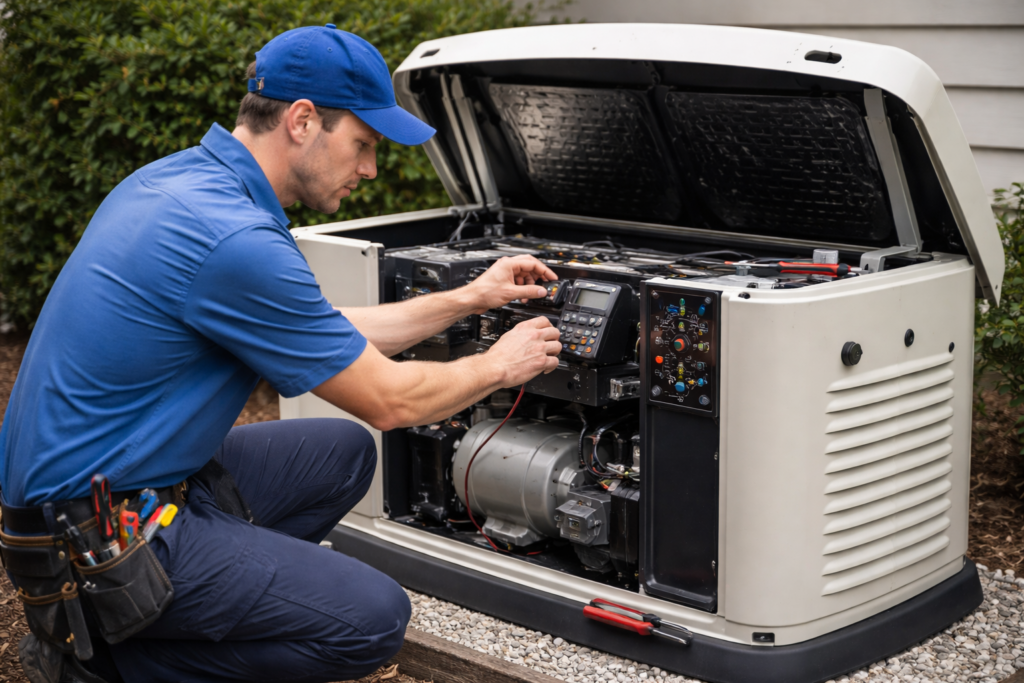
Are There Electrical Faults or Tripped Breakers?
Sometimes the engine runs, but you aren’t getting electricity to your home. Or, the control panel itself might be unresponsive.
- Check the Main Breaker: Look at the circuit breaker on the generator itself. If it has tripped to “OFF,” reset it.
- Inspect the Transfer Switch: Ensure your transfer switch is correctly set to accept power from the generator.
- Look for Error Codes: Many modern standby generators have a digital display that will show an error code (e.g., “RPM Sense Loss” or “Under Voltage”). Note this code, it’s vital information for your technician.
When Should You Call a Professional?
While these DIY checks can solve simple issues, generators are complex, high-voltage machines. If you’ve checked the fluids, battery, and plugs and the unit still won’t start, it’s time to call in the experts.
You should contact Magic Electric, Plumbing, Heating & Air if:
- You smell gas or burning odors (Safety Hazard!).
- There is visible damage to wires or the unit housing.
- The generator makes loud clanking or grinding noises when trying to start.
- You are uncomfortable working with engine components or electricity.
Our technicians in Twin Falls, ID, have the tools to diagnose home generator’s deep mechanical failures, control board issues, and complex electrical faults. We perform correct repairs at an honest price, ensuring your home isn’t left in the dark.
Conclusion
A generator that won’t start defeats the purpose of having one. By performing regular maintenance, like checking oil levels, testing batteries, and cycling the fuel, you can prevent most of these issues. However, when troubleshooting fails, professional repair is the safest and most reliable route.
Don’t wait for the next storm to find out your system is down. Contact Magic Electric, Plumbing, Heating & Air today to schedule a maintenance check or repair. We’re not happy until you’re happy!
Home Generator Won’t Start: Frequently Asked Questions (FAQ)
Q: How often should I check my generator if I haven’t used it?
A: You should inspect your generator at least once every 6 months. Most manufacturers recommend “exercising” the generator (running it for about 20 minutes) once a month to keep the battery charged and the internal components lubricated.
Q: Can old gas really stop my generator from starting?
A: Yes, absolutely. Gasoline degrades over time and can turn into a varnish-like substance that clogs the carburetor jets. If you store your generator with gas in it, use a fuel stabilizer. If gas has been sitting for more than 6 months without stabilizer, it should be drained and replaced.
Q: Why does my generator click but not start?
A: A rapid clicking sound usually indicates a dead or weak battery. It has enough power to engage the starter solenoid (the click) but not enough energy to turn the engine over.
Q: Is it safe to repair a generator myself?
A: Basic troubleshooting like checking oil, air filters, and spark plugs is generally safe for homeowners. However, any work involving the electrical panel, internal engine repair, or gas lines should be handled by a licensed professional like Magic Electric, Plumbing, Heating & Air to avoid injury or fire hazards.
Q: What do I do if my generator starts but then shuts off after a few seconds?
A: This is a classic symptom of low oil or a clogged fuel filter. The engine starts, but the sensor detects low oil pressure and kills the engine to protect it. Check your oil levels first.