
Choosing a new water heater is one of the most impactful decisions a homeowner makes. It’s an investment that affects your daily comfort, your utility bills, and your home’s long-term value for a decade or more. For years, the traditional storage tank water heater was the only option, a reliable fixture tucked away in the closet or basement. Today, however, homeowners have a powerful alternative: the high-efficiency tankless water heater, also known as an on-demand system.
The choice between these two giants isn’t just about the initial price tag; it’s about calculating the True Cost of Ownership (TCO). This comprehensive financial perspective looks far beyond the unit’s price to factor in installation complexity, annual energy waste, maintenance demands, and life expectancy. It answers the question: which system truly offers the best value over its entire service life?
Here at Magic Electric, Plumbing, Heating & Air, we specialize in both traditional and tankless systems, serving homeowners throughout Twin Falls, Boise, and surrounding communities. We understand that this decision can feel overwhelming. That’s why we’ve broken down the true long-term costs and energy implications of each system, so you have the factual information you need to make a smart and confident decision for your home and your budget.
If you’re ready to dive into the details, from BTU ratings and energy factors to standby loss and flow rates, we’re here to guide you. Let’s start counting the costs, calculating the savings, and finding the perfect long-term solution for your hot water needs.
What is the Primary Difference Between Tanked and Tankless Water Heaters?
The core difference between these two systems boils down to one fundamental concept: how and when the water is heated. This single difference is responsible for nearly every variation in cost, efficiency, and performance you will experience.
The Storage Tank System (Tanked)
A conventional, or tanked, water heater operates on a simple principle: storage and standby.
- Mechanism: It consists of a large, insulated tank (typically 40 to 80 gallons) that constantly holds and maintains a predetermined volume of hot water.
- Operation: The system heats the entire tank of water to a set temperature (e.g., 120°F). Once heated, it relies on the tank’s insulation to keep the water warm until you need it.
- The Standby Cycle: Because no insulation is perfect, the water gradually cools down. When the water temperature drops below a certain point, the heating element (gas burner or electric coil) automatically kicks on to reheat the entire volume. This continuous reheating is known as eliminating standby heat loss.
The Tankless System (On-Demand)
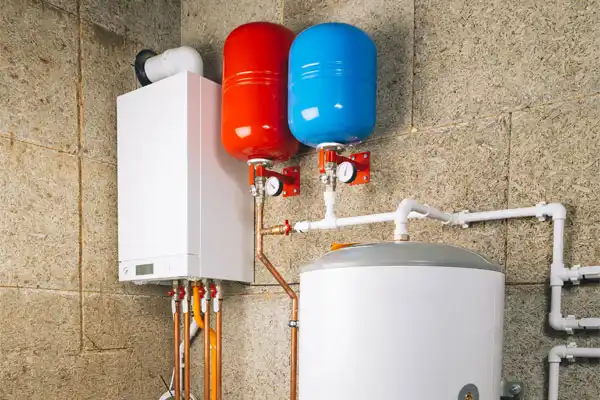
A tankless water heater, by contrast, operates purely on demand. It stores no water and is typically about the size of a suitcase, mounted directly on a wall.
- Mechanism: When a hot water faucet or appliance turns on, cold water travels through a pipe into the tankless unit.
- Operation: A flow sensor activates a powerful heating element (either a gas burner or electric coils). The water is rapidly heated as it passes through a heat exchanger, and then it’s delivered instantly to the point of use.
- The Savings Key: Since it only heats water when needed, the system doesn’t spend any energy maintaining a hot reserve, completely eliminating standby heat loss.
This fundamental difference means the tanked unit prioritizes ready availability (if the tank is full), while the tankless unit prioritizes ultimate energy efficiency.
Where Do the Upfront Costs Truly Differ Between the Two Systems?
When comparing the sticker price, tankless units appear significantly more expensive. However, to understand the initial investment fully, you’ll need to compare three separate financial components: the unit cost, the installation labor, and the potential infrastructure upgrades.
1. Unit (Equipment) Purchase Price
The purchase price of the equipment itself shows a clear disparity between the two technologies.
- Traditional Storage Tank Units are generally less complex, utilizing older, widely-produced technology, resulting in a unit cost typically ranging from $300 to $2,000.
- Tankless Water Heater Units are built with advanced heat exchangers, complex electronics, and high-powered burners. This technology drives the initial purchase price higher, usually between $1,000 to $3,000.
2. Standard Installation Labor Costs
The cost of installation is highly dependent on whether you are replacing a similar unit or upgrading your technology.
- Tanked Installation: Replacing an old tank with a new tank is typically a straightforward, quick job because the existing connections for water lines, gas lines, and venting are already in place and correctly sized. Standard installation labor costs generally run between $400 and $1,000.
- Tankless Installation (Basic Swap): The initial installation labor for a tankless unit is often more complex and time-consuming than a tanked swap. Even a basic conversion can range from $1,000 to $2,500 or higher.
3. Infrastructure Upgrade Costs (The Tankless Variable)
This is the hidden cost that can drastically inflate the initial investment for a tankless conversion. Tankless systems demand far more fuel or power in a brief period to deliver instantaneous heat.
Necessary Upgrades for Tankless:
- Gas Line Sizing: Gas tankless units often require a significant upgrade, moving from a standard 1/2-inch gas line to a 3/4-inch line to handle the required BTU load (often exceeding 199,000 BTUs/hour).
- Venting Requirements: Gas tankless units need specialized, high-efficiency, or larger-diameter venting (such as PVC or stainless steel) that may require cutting into walls to vent horizontally, unlike the simple vertical flue of a standard tank.
- Electrical Capacity: Electric tankless units demand massive electrical capacity. Many homes need a dedicated panel upgrade and the installation of new, high-amperage circuits (sometimes multiple 40-amp circuits) just to power the unit safely.
Depending on your home’s current setup, these mandatory infrastructure upgrades alone can add anywhere from $1,000 to over $3,000 to the total installation cost of the tankless system. This is the primary reason the initial TCO for tankless is always higher.
How Does Standby Heat Loss Affect Annual Operating Expenses?
The most critical factor in the long-term cost battle is energy efficiency, which is determined by whether the system continuously wastes energy.
The Cost of Standby Heat Loss
In a traditional storage tank water heater, the unit uses energy 24 hours a day, 7 days a week, regardless of whether you are running a hot water tap. This is the definition of standby heat loss, the continuous effort to keep 40 to 80 gallons of water hot in reserve.
- The Energy Waste: Experts estimate that heat loss accounts for 15% to 20% of the energy consumed by a conventional tank system. This persistent energy drain directly translates into higher utility bills.
- Annual Operating Cost (Tanked): Generally ranges from $200 to $800 per year depending on the fuel source and local utility rates.
The Savings of On-Demand Heating
Tankless water heaters only consume energy during the moment water is flowing. When the tap is off, the unit is completely off. This elimination of standby loss is the engine behind their impressive energy savings.
- The Energy Efficiency: Tankless water heaters can be 8% to 34% more energy efficient than conventional storage tank models. The highest percentage savings are usually seen in homes that use less than 41 gallons of hot water daily, as there is less hot water standing idle.
- Annual Operating Cost (Tankless): Operational costs drop significantly, often down to under $100 to $500 per year. Gas tankless models tend to be the most cost-effective over time.
Key Takeaway: The tankless unit is designed to generate savings every single day, year after year, by precisely eliminating the wasted energy inherent in maintaining a large, continuously hot reserve of water.
Does the Longer Lifespan of Tankless Heaters Really Justify the Higher Initial Price?
Yes, the difference in service life is arguably the most important factor when stretching the True Cost of Ownership calculation over 20 years or more.
A Look at Lifespan Expectations
The durability and expected life cycle of the two units vary dramatically:
- Traditional Storage Tank Water Heaters have an average service life of only 10 to 15 years. If you live in a home for 30 years, you will likely need 2 or 3 full unit replacements.
- Tankless Water Heaters are built to last much longer, with an average lifespan of 20 years or more (often extending to 25 or 30 years with proper maintenance). In a 30-year span, you may only need one unit, or potentially one-and-a-half.
Why Tankless Lasts Longer
The extended life of an on-demand system is due to mechanical differences:
- Reduced Corrosion Risk: A tanked heater is a metal vessel constantly holding water, which inevitably leads to rust and corrosion, even with an anode rod. When the tank lining fails, the unit leaks and must be replaced. Tankless units have no storage reservoir, eliminating this failure point.
- Modular Construction: Tankless units are designed with components such as the flow sensor, heat exchanger, or ignition, that can be individually repaired or replaced by a professional plumber. A conventional tank failure, conversely, usually requires total replacement.
The Financial Impact:
This deferred replacement cost is highly valuable. If a tankless unit costs $4,500 installed but lasts 25 years, the cost of replacing the entire system is postponed for over two decades, allowing the significant energy savings to accumulate and generate a net financial gain long before you need to reinvest in new equipment. The extended lifespan significantly reduces the overall capital expenditure requirement in the TCO calculation.
What Are the Performance Trade-offs Homeowners Must Consider?
Cost and efficiency are essential, but performance directly impacts your daily life. The two systems behave differently when faced with high hot water demand, particularly simultaneous usage.
Tanked: Capacity and Recovery
- Pros: A conventional unit provides a large, immediate burst of hot water simultaneously to multiple fixtures (e.g., dishwasher, washing machine, and two showers). This works well for peak demand households.
- Cons: Once the tank is emptied, the hot water supply stops. You have to wait for the unit’s recovery rate, which is the time it takes to heat the entire volume again. This process can take 30 minutes or more, which often leaves the next user with cold water.
Tankless: Flow Rate and Simultaneous Use
- Pros: Provides a continuous, endless supply of hot water. The hot water will never run out, making it ideal for long showers or continuously filling a large soaking tub.
- Cons (Flow Rate Limits): Tankless units are limited by their flow rate, measured in Gallons Per Minute (GPM). A standard whole-house unit produces approximately 8 to 10 GPM. If demand exceeds the unit’s GPM capacity (e.g., three people showering while the dishwasher is running), the unit can’t heat the water fast enough, and the water temperature delivered to all fixtures will drop, potentially resulting in lukewarm water.
The Need for Professional Sizing: For homes in Twin Falls and Boise with high-demand habits (e.g., three or more full bathrooms), professional sizing by an expert from Magic Electric is non-negotiable. We often recommend installing two smaller tankless units (one dedicated to the primary bath/kitchen and one for secondary use) to ensure the household never experiences a flow rate issue.
How Does Maintenance Impact the True Cost of Ownership?
Both types of water heaters require maintenance, but the tasks and their importance differ significantly, especially in areas with hard water, which is common throughout Idaho. Maintenance costs are an unavoidable part of the long-term TCO.
Maintenance for Storage Tank Water Heaters
Maintenance for a tanked unit is focused primarily on preventing corrosion and clearing sediment buildup.
- Annual Tank Flush: This is the most vital task. Draining the tank once a year removes heavy sediment (minerals like calcium and magnesium) that collects at the bottom. Sediment acts as an insulator, forcing the heating element to work harder, which drastically reduces efficiency and shortens the unit’s life.
- Anode Rod Inspection: The anode rod protects the tank lining by corroding itself instead of the metal tank. It must be inspected and usually replaced every 5 to 7 years to ensure the tank does not rust out prematurely.
Maintenance for Tankless Water Heaters
Maintenance for a tankless unit is focused on keeping the heat exchanger clean and clear.
- Annual Descaling/Flushing: Tankless units must be flushed with a descaling solution (usually an acidic product) at least annually. Minerals build up rapidly on the highly specialized heat exchanger coils, restricting water flow and severely inhibiting heating efficiency. This requires a professional plumber using a special pump kit.
- Water Quality Management: In regions with high mineral content, such as many of the areas we service, a whole-house water softener or filtration system is often highly recommended, or even mandated by the manufacturer, to prevent premature failure and maintain the warranty.
While tankless units offer a longer lifespan, they require more precise, mandatory maintenance. Neglecting the annual descaling can quickly undo the unit’s efficiency gains and drastically shorten its life, reinforcing the fact that maintenance cost is a critical component of the True Cost of Ownership.
How Can Homeowners Best Calculate Their Individual Break-Even Point?
To accurately calculate your personal break-even point, which is the moment the higher initial investment of a tankless system is fully recovered by energy savings, you must use your home’s specific data.
Follow these steps for a simple TCO comparison using estimated numbers:
1. Determine the Total Initial Cost (I.C.)
This step requires combining the unit cost and the professional installation/upgrade costs.
- Example Total Initial Cost for a Tanked System: A mid-range tank unit might cost $1,000, and standard labor adds $600, resulting in a total initial cost of $1,600.
- Example Total Initial Cost for a Tankless System: A high-efficiency gas tankless unit might cost $2,000, but adding necessary gas line and venting upgrades could add $2,500 in labor and materials, leading to a total initial cost of $4,500.
2. Estimate Annual Energy and Maintenance Costs (A.C.)
Calculate the ongoing operational expense for each unit.
- Tanked Annual Cost: Estimated Annual Energy Bill ($450) plus routine maintenance ($50) equals an annual cost of $500.
- Tankless Annual Cost: Estimated Annual Energy Bill ($250) plus mandatory descaling maintenance ($100) equals an annual cost of $350.
Conclusion
The debate between tanked and tankless water heaters is ultimately a debate between upfront expenditure and long-term investment.
- If your priority is the lowest possible upfront cost and you have adequate space, the traditional storage tank water heater is the reliable, quick-install option. You accept the trade-off of higher monthly utility bills and a guaranteed replacement every 10 to 15 years.
- If your priority is maximum energy efficiency, unlimited hot water, and the lowest True Cost of Ownership over a 20-year span, the tankless water heater is the superior investment. You accept the trade-off of a much higher initial cost and slightly more complex annual maintenance.
In many cases, the longer lifespan and significant energy savings of a modern tankless system make it the clear winner for homeowners focused on long-term financial health and environmental impact.
No matter which system you choose, proper installation and maintenance are essential to maximizing its efficiency and lifespan. Magic Electric, Plumbing, Heating & Air is fully licensed and equipped to handle the specialized installation and routine maintenance of both conventional and tankless water heaters.
Contact Magic Electric, Plumbing, Heating & Air for your plumbing and electrical repair needs, or to schedule a professional consultation and TCO analysis for your water heater replacement today!
Tanked vs. Tankless Water Heater Energy Savings: Frequently Asked Questions (FAQ)
1. Does a tankless water heater provide truly instant hot water?
Answer: No, a tankless water heater does not provide truly instant hot water. It provides on-demand hot water, meaning the unit instantly begins the heating process as soon as you open a hot water tap. The water still has to travel from the unit, through the plumbing pipes, to your faucet or showerhead. The delay you experience (often a few seconds) is the time it takes to flush the standing cold water out of the pipes. However, tankless units never “run out” of hot water, providing an endless supply once the flow is established.
2. Is it true that electric tankless water heaters are much more expensive to run than gas models?
Answer: Yes, this is generally true. While all tankless water heaters are highly efficient compared to their storage tank counterparts, gas (natural gas or propane) models typically have lower operating costs. This is because, in most regions, the cost of natural gas or propane required to produce the same amount of heat (BTUs) is significantly lower than the cost of electricity. Electric tankless heaters also require very high electrical input, making the operation costly if electricity rates are high. For the greatest long-term savings, a natural gas tankless unit is usually the winner.
3. What is the typical flow rate for a whole-house tankless water heater?
Answer: The typical flow rate for a residential whole-house tankless gas water heater is between 8 and 10 gallons per minute (GPM). Electric models generally have a lower GPM, especially in cold climates. This GPM rating is critical because it dictates how many fixtures you can run simultaneously while maintaining the desired temperature. For example, a system rated at 8 GPM can handle running two 2.5 GPM showers and two 1.5 GPM faucets comfortably. If your demand is higher, a larger or multiple-unit system may be required.
4. Are there any tax credits or rebates available for installing a tankless water heater?
Answer: Yes, sometimes. Tankless water heaters that meet specific Energy Star ratings for energy efficiency may qualify for federal, state, or local utility rebates or tax credits. These incentives can change frequently and vary widely based on your location and the specific model installed. Check the latest information provided by the Department of Energy (DOE) and local utility providers in areas like Twin Falls and Boise before installation, as these savings can help reduce the initial upfront cost significantly.