
The circuit breaker panel, that seemingly innocuous gray metal box tucked away in your basement or garage, is arguably the most important safety device in your entire home. It’s the nerve center of your electrical system, acting as the first line of defense against electrical fires and dangerous short circuits.
Your circuit breakers are highly tuned safety valves. They permit a specific, safe amount of power (current) to flow through a dedicated circuit in your home. The moment too many amps try to rush through, a situation known as an overload, the breaker executes its fundamental job: it trips, cutting the power instantly to prevent the wiring from overheating.
While an occasional trip is normal (in fact, it means the safety system worked), frequent, consistent, or unusual signs of trouble should never be ignored. A failing circuit breaker is more than just a momentary inconvenience that cuts off power to your kitchen. It’s a fire hazard that puts your family and property at risk.
At Magic Electric, Plumbing, Heating & Air, we specialize in diagnosing and resolving the underlying issues that plague residential electrical systems. We understand that homeowners often overlook electrical panel maintenance until a crisis hits. That’s why we’ve compiled the five most common and critical warning signs that your circuit breaker is nearing mechanical failure and needs immediate professional repair or replacement.
If you observe even any of these five signs, it’s time to contact Magic Electric, Plumbing, Heating & Air. We will provide prompt, expert service to ensure your home remains safe and powered efficiently.
1. Why Do My Circuit Breakers Keep Tripping, Even with Low Usage?
Frequent tripping is the clearest and most common indicator that your circuit breaker, or the circuit it protects, is in distress.
A circuit breaker is designed to trip for a reason: either an overload (too many devices drawing power) or a short circuit (a wiring fault). However, if you find yourself constantly having to reset the same breaker, it transitions from being an inconvenience to a critical warning sign.
What Differentiates a Normal Trip from a Failure Symptom?
- Normal Trip: This happens when you knowingly plug in a high-wattage appliance on an already strained circuit. For example, simultaneously running a laser printer and a space heater on the same dedicated line.
- Warning Trip: This is when the breaker trips:
- Immediately after you reset it, even if all appliances are unplugged.
- When you only use a single, modest appliance that the circuit should easily handle.
- Randomly, with no apparent change in the electrical load.
The Underlying Causes of Chronic Tripping
Constant tripping places enormous strain on the breaker’s internal thermal and magnetic components. This wears out the mechanism, meaning it might eventually fail to trip when a real, dangerous electrical fault occurs.
The causes usually fall into three categories:
- Persistent Overload and Obsolete Capacity:
- Older homes often operate on electrical panels rated for 60 to 100 amps.
- Modern homes, with central air conditioning, high-efficiency furnaces, multiple televisions, computers, and dedicated charging stations, typically require 150 to 200 amps or more.
- When an older panel attempts to manage this modern demand, the circuits are constantly stressed, leading to frequent, persistent trips.
- Worn-Out Breaker Mechanism:
- After decades of service or dozens of major tripping events, the internal springs, levers, and contacts wear down.
- A worn breaker might become overly sensitive, tripping under normal conditions, or conversely, it might become sluggish, failing to trip during a dangerous overcurrent event.
- Undetected Wiring Faults:
- Short circuits or ground faults create massive, instantaneous current surges. The breaker is doing its job, but the underlying fault in the wiring is extremely dangerous.
- If the breaker trips immediately upon resetting, you likely have a persistent fault that needs immediate professional intervention.
If you’re continuously resetting the same breaker, stop. Repeatedly resetting a faulty breaker can worsen internal damage and increases the risk of igniting an electrical fire within your panel.
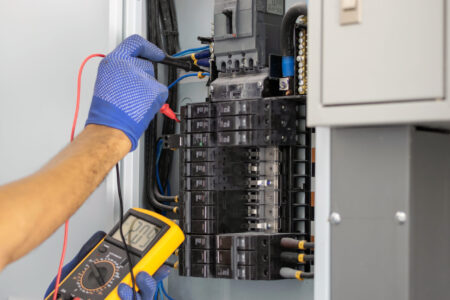
2. Is That Burning Smell Coming From My Electrical Panel a Fire Risk?
Yes. An audible or olfactory sign of heat is a dire and immediate warning. If you detect any unusual odor coming from your breaker panel, near an outlet, or in a specific room, treat it as an emergency.
What Does the Smell Indicate?
The smell is typically described in one of three ways:
- Acrid/Smoky Odor: This is the most direct sign, indicating that the wire insulation or plastic components inside the electrical panel or wall are actively overheating and melting.
- Metallic Odor: Suggests internal components within the breaker or panel itself are burning, often a result of arcing or component failure.
- “Fishy” Odor: This is a common, though surprising, indicator of plastic overheating, specifically, the plastics used in electrical component housing and wire jackets.
Why Is the Overheating Occurring?
The dangerous heat generating these smells is usually caused by a few serious issues:
- Loose Connections (The #1 Culprit): Over time, due to vibration, heat cycling, and simple metal fatigue, the terminal screws securing the main wires to the breaker can loosen. This creates a high-resistance point where the electrical current struggles to pass through the compromised connection. The friction and resistance generate intense, localized heat.
- Arcing: A loose connection can cause electricity to “arc” or jump across a small air gap. This is akin to a tiny, continuous lightning strike within the panel, which generates extreme temperatures and rapidly degrades the system.
- Internal Breaker Failure: The breaker itself has failed to interrupt an overcurrent, allowing dangerous levels of heat to build up inside its casing, causing the plastic to melt.
Immediate Action Steps for a Burning Smell:
- Do Not open the panel or attempt to feel the breaker.
- If you can safely locate the main service disconnect (the master switch that shuts off all power to the entire house), turn it OFF immediately.
- If the smell is strong or if smoke is visible, evacuate the home and call emergency services.
- Call Magic Electric, Plumbing, Heating & Air right away. Our licensed electricians treat burning smells as an emergency because it means damage is actively occurring, and the system’s primary safety function may have failed.
In addition to the smell, look for scorch marks, soot, or discoloration on the panel cover, the individual breaker switches, or the wall directly behind the panel. Blackened or charred plastic is visual evidence of a critical and ongoing failure.
3. Why is My Circuit Breaker or Electrical Panel Hot to the Touch?
Your circuit breaker panel should always feel cool to the touch. It is designed to dissipate any ambient heat quickly. While it may feel slightly warm after hours of continuous, heavy use (such as on the hottest day of summer), it should never be excessively warm or hot enough to cause discomfort when touched.
The Warning Sign of Thermal Buildup
A hot breaker switch or a hot section of the panel cover indicates that components are under severe stress and are failing to handle the electrical load efficiently. Heat is simply energy that is being wasted, and in an electrical system, wasted energy signifies:
- Excessive Resistance: Loose connections or worn internal contacts are creating friction that converts electrical energy into heat energy.
- Consistent Overloading: The circuit, or even the main service wires feeding the panel (bus bars), is consistently carrying more current than it can safely handle.
Common Areas of Excessive Heat:
- The Main Breaker: If the main switch is hot, it indicates a potential problem with the main service wires or the bus bars, which is a severe safety hazard impacting the entire home.
- Individual Breaker Switches: If a single breaker is hot, it means that specific circuit is either drawing too much power or the breaker itself is internally defective.
- Surrounding Outlets/Switches: If the wall outlet or light switch plate connected to the panel feels hot, it points to localized wiring issues behind the wall, often due to loose terminals or faulty receptacle devices.
Comparative Insight: Loose Connections
Often, competitive analysis shows that technicians primarily focus on replacing a tripping breaker. However, a highly skilled professional from Magic Electric, Plumbing, Heating & Air understands that the heat itself is often caused by a loose connection outside of the breaker, possibly on the main bus bar connection. A proper repair requires isolating the power and physically tightening all wire connections to ensure minimal resistance and optimal safety.
If you feel heat emanating from the panel, do not attempt to touch it again or open it. Shut off the main power if possible and call a licensed professional to inspect the issue immediately.

4. What Do Flickering Lights and Poor Appliance Performance Tell Me?
Flickering lights are often the most subtle, yet persistently noticeable, sign that your circuit breaker or the overall electrical service is compromised.
If your lights noticeably dim, flicker, or brighten when you turn on a large appliance such as your microwave, oven, or central air conditioner, it signals that the electrical system is struggling to provide consistent, stable voltage.
Symptoms of Power Instability:
- Intermittent Dimming: Lights dim momentarily when a refrigerator compressor kicks on or a high-powered tool starts up. This indicates that the electrical system is experiencing a voltage drop due to an overloaded circuit or insufficient service capacity.
- Appliance Malfunctions: Your electric stove is baking unevenly, or your clothes dryer takes longer and sometimes shuts off mid-cycle. This isn’t necessarily a problem with the appliance. It’s a lack of consistent, sufficient power from the panel causing the device to perform poorly.
- Random Power Losses: Electronics, such as computers or televisions, occasionally reboot or lose power for a split second before regaining it. This points to loose or deteriorating connections inside the panel or in the main service wiring.
Why is Inconsistent Power Dangerous?
Beyond the annoyance, inconsistent power can have significant safety and financial implications:
- Appliance Damage: Voltage fluctuations shorten the lifespan of sensitive electronics and expensive appliances, leading to costly replacement sooner than expected.
- Hidden Fire Hazard: Flickering lights are a physical symptom of a deeper problem: loose wiring or connections. As discussed, loose connections cause arcing and intense overheating, significantly increasing the risk of fire behind your walls or inside the electrical panel.
A healthy electrical system distributes power evenly and reliably. If this reliability is compromised, an electrician from Magic Electric, Plumbing, Heating & Air can diagnose whether the cause is a defective individual breaker, faulty branch wiring, or a systemic issue requiring a full panel upgrade to safely accommodate your load.
5. Why Is My Breaker Buzzing or Wobbly, and How Does Age Factor In?
The last two warning signs are what you hear and what you see on the breaker switch itself, coupled with the age of the installation.
The Sound of Trouble: Buzzing and Crackling
Your electrical panel should operate silently. If you hear any unusual sounds, such as a buzzing, humming, or crackling noise, coming directly from the panel, it’s a serious indicator of an electrical fault.
- Buzzing/Cracking: These sounds usually signify electrical arcing. Arcing occurs when electricity jumps across a small gap between two components, such as a loose wire terminal or worn contact points inside a failing breaker. This generates high heat and rapidly degrades the system, posing an immediate fire threat.
The Feel of Failure: Loose Switches and Physical Damage
Circuit breaker switches are mechanical devices designed to move firmly. They should snap into the ON and OFF positions with a distinct, positive click.
- Wobbly or Loose Switch: If the breaker switch feels loose, spongy, or wobbly when you try to toggle it, the internal switching mechanism is likely damaged or worn out. A compromised mechanism may fail to trip during an emergency or fail to hold the ON position.
- Physical Damage and Corrosion: Visibly inspecting your panel for signs of damage is essential. Look for:
- Cracked or Broken Breaker Housings: Indicates external damage or thermal stress.
- Rust or Corrosion: Signals moisture infiltration. Moisture and electricity are a dangerous combination, as corrosion increases resistance, leading to overheating, arcing, and failure.
The Inevitability of Age
Finally, consider the age of your panel. Even if your system seems fine, an electrical panel over 25 years old is operating on borrowed time.
- Outdated Technology: Older panels often lack modern safety features like AFCI (Arc Fault Circuit Interrupters) and GFCI (Ground Fault Circuit Interrupters), which are now required by code and offer superior protection against common fire causes.
- Technology Obsolescence: Breakers degrade. The internal components, such as springs and bi-metallic strips, lose their responsiveness over time due to years of heating and cooling cycles.
If your panel is nearing or past the 25-year mark, even without severe symptoms, it is highly recommended to schedule an electrical safety inspection with Magic Electric, Plumbing, Heating & Air. A proactive replacement is always safer and less costly than an emergency failure.
Conclusion
The five signs are frequent tripping, burning smells, a hot panel, power fluctuations, and mechanical failure. They are the most important warnings your home’s electrical system can give you. Ignoring them is taking a dangerous gamble with your property and the safety of your family.
A malfunctioning circuit breaker is never a DIY fix. Handling electricity requires specialized knowledge, licensed experience, and adherence to strict safety codes. Attempting self-repair can lead to severe injury, electric shock, or a catastrophic electrical fire.
The licensed and insured electricians at Magic Electric, Plumbing, Heating & Air have the expertise, equipment, and training to accurately diagnose the root cause of the problem, whether it is faulty wiring, an overloaded circuit, or a defective breaker itself.
We are committed to the safety of our customers, offering same-day service, upfront pricing, and a guarantee of clean, professional workmanship. Don’t wait for a flicker to become a fire. If you notice any of these five common signs, contact Magic Electric, Plumbing, Heating & Air for your plumbing and electrical repair needs and ensure your home’s electrical system is safe, reliable, and up to code today.
Circuit Breaker Repair: Frequently Asked Questions (FAQ)
What is the primary function of a circuit breaker, and how is it different from a fuse?
A circuit breaker is a reusable safety device designed to protect an electrical circuit from damage caused by excess current, which is typically the result of an overload or a short circuit. When an issue occurs, the breaker automatically interrupts the flow of electricity by physically flipping a switch to the OFF position. The key difference from an old-fashioned fuse is that a breaker is designed to be reset and reused after the fault is cleared. A fuse contains a metal strip that melts (blows) when current is too high and must be replaced entirely, making the circuit breaker a much more convenient and modern form of circuit protection.
How often should I have my circuit breaker panel inspected?
It is generally recommended to have your main electrical panel and circuit breakers professionally inspected every 5 to 10 years, particularly if your home is more than 20 years old or if you have an older-style panel. However, if you have recently added major high-draw appliances (such as a heat pump, electric car charger, or large power tools) or if you are experiencing any of the five warning signs listed in this article, an inspection should be performed immediately, regardless of the last service date. Regular inspections help catch loose connections, corrosion, and internal wear before they escalate into dangerous failures.
Can I just keep resetting a frequently tripping circuit breaker?
No, you should never repeatedly reset a circuit breaker that trips frequently. While resetting it once or twice is acceptable to clear a temporary overload (like after plugging in too many holiday lights), continuous tripping indicates a persistent and serious underlying issue, such as a worn-out breaker, an unresolved short circuit, or a severely overloaded wire. Repeatedly forcing the breaker back on subjects the faulty wiring and components to dangerous heat and electrical stress, which significantly increases the risk of a system failure or an electrical fire. If a breaker trips immediately after being reset, leave it off and call a professional electrician.
What are the dangers of ignoring a hot or buzzing circuit breaker?
Ignoring a hot or buzzing circuit breaker presents an extremely high risk of an electrical fire.
- Heat: A hot breaker indicates intense resistance and overheating. This heat can quickly melt the plastic insulation surrounding the wiring, allowing bare, energized wires to touch, resulting in a short circuit and fire.
- Buzzing/Crackle: These noises signify arcing, which is electricity jumping across a gap. Arcing generates temperatures high enough (upwards of 10,000 degrees Fahrenheit) to rapidly ignite combustible materials, including the surrounding wood and drywall structure of your home, in seconds. Immediate action is required.
How long do circuit breakers typically last before needing replacement?
Most standard thermal-magnetic circuit breakers are engineered to last between 25 and 40 years. However, their lifespan is highly variable and can be significantly shortened by poor conditions such as constant exposure to humidity, dust, excessive heat, and, most commonly, frequent tripping. Due to the rapid increase in home electrical demand over the last few decades, many older panels need replacement sooner, not necessarily because the breaker physically failed, but because the panel’s low amperage capacity is now obsolete and inadequate for modern use.